Jennie Jieun Lee is an internationally recognized artist known for her ceramic sculptures and bright, painterly glaze work. Her first solo museum exhibition, “Jennie Jieun Lee: Luteal Elements and Grooves,” is now on view at the Aldrich Contemporary Art Museum in Ridgefield, Connecticut, through May 25.
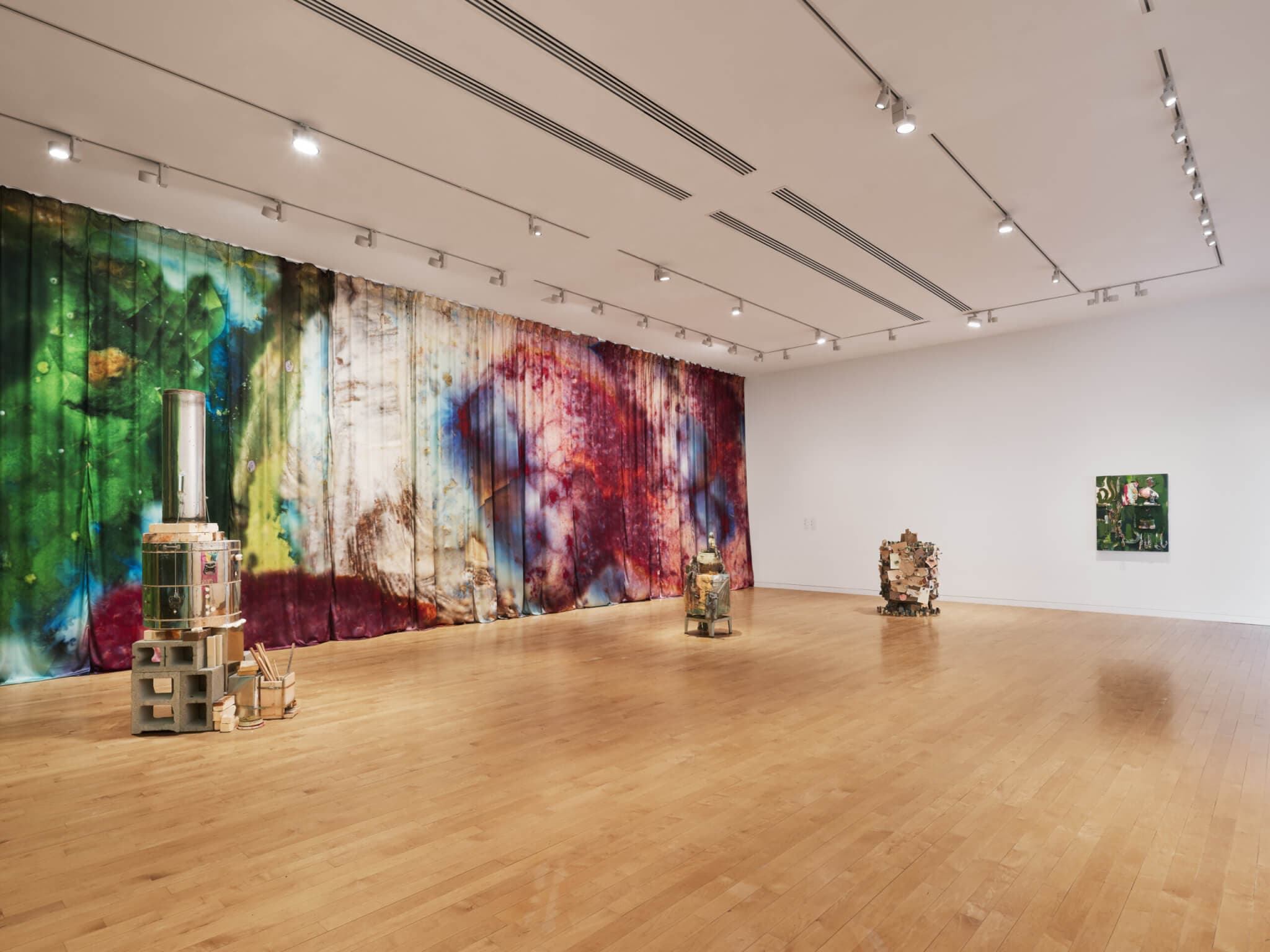
The exhibition features eight works, four of which were made for this exhibition. In these new works, electric kilns are a prominent feature. Kilns are expensive and clunky utilitarian objects, so using them as primary components in these sculptures is a clear declaration of the artist’s obsession with material, process, and community care. In the clay world, the process is deeply communal, with members of a studio sharing everything from clay body and glaze ingredients and recipes to kiln firings and electricity costs. One person might be responsible for firing the work of several artists in the same studio and that person can change firing to firing. Lee’s new works are large-scale assemblages fashioned from defunct, community-sourced kilns with hand-built ceramic or hand-written text-based components. She obtained the kilns through social media and email, asking other ceramic artists for any electric kilns that were no longer needed or in use.
Two of the four kiln-sculptures are stand-outs. Figures (2025), brings two of the exhibition’s central themes—identity and memory—into focus. Five handbuilt figurines sit atop or on the edge of an electric kiln. Lee constructed these figures during a residency at Township10 in North Carolina using a local, soil-rich wild clay made by Starworks Ceramics, which—when fired—renders the rough-hewn and expressive figures a deep umber-bronze color. One figurine stands on the floor, leaning against the kiln with her arms crossed in front of her belly. This is a recognizable pose for people in their luteal stage, the second half of the menstrual cycle where rapid changes in hormones can cause a variety of symptoms including bloating, mood changes, breast tenderness, fatigue, and abdominal pain that might lead a person to hold this pose. In the accompanying audio, the artist indicates these are a return to self-portraiture at a time when her own hormones are dramatically changing; she says, “clay will always be the perfect recorder of time.”
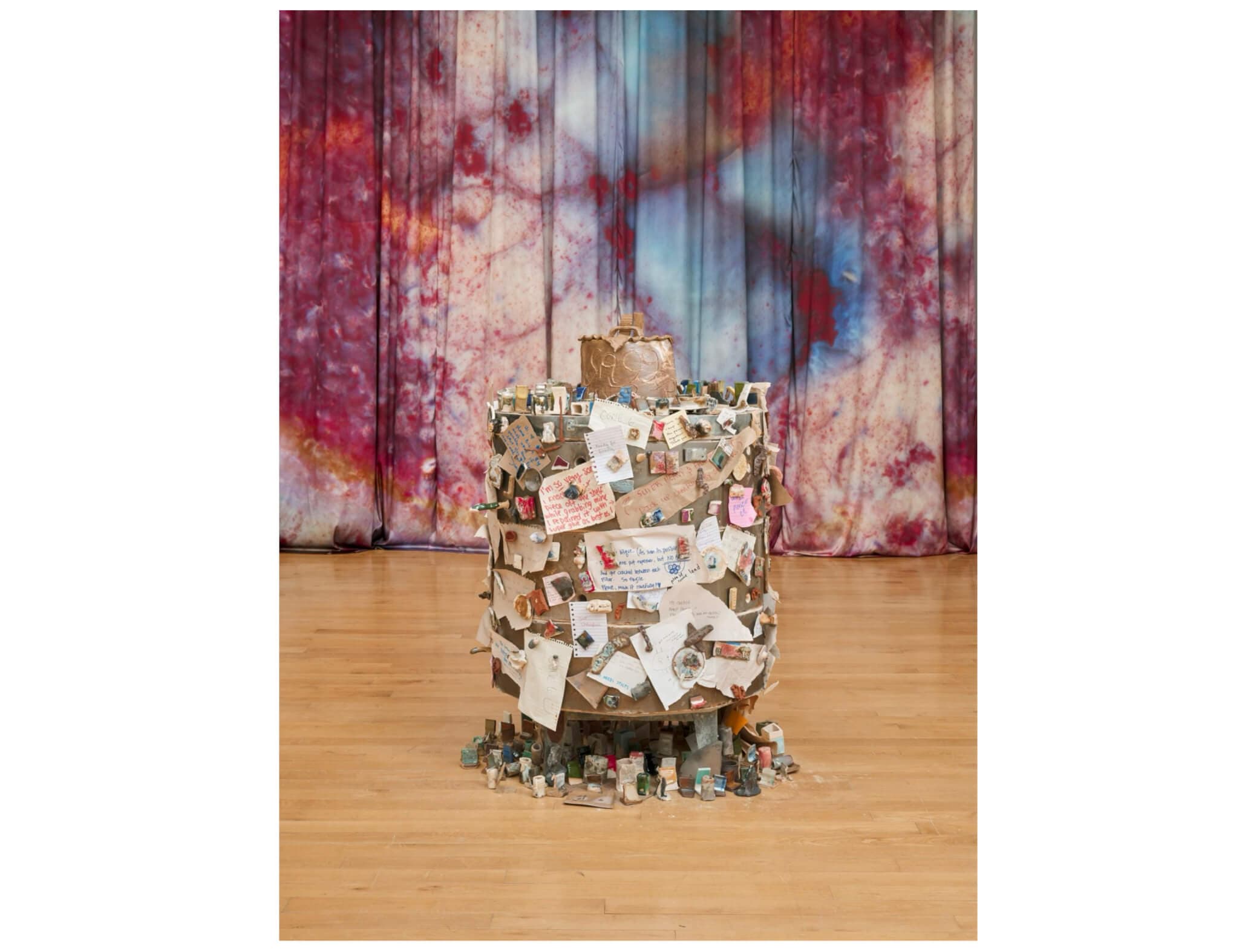
Jennie Jieun Lee, (back) Slow Cool, 15 min hold, 2025, and (front) Message Kiln, 2025. Installation view, “Jennie Jieun Lee: Luteal Elements and Grooves,” The Aldrich Contemporary Art Museum, January 25 to May 25, 2026. Photo by Olympia Shannon. Courtesy of the artist, Nicelle Beauchene Gallery, New York, and Cooper Cole Gallery, Toronto.
If Figures is a record of self over time, Message Kiln (2025) is a chronicle of relationships. This kiln is covered in a collection of one year’s worth of notes left between her Tufts students and staff who used the communal studio kiln on a weekly basis. Some of the notes are instructional on ripped scraps of paper “cone 06 lowfire please” or “needs to be fired by Tuesday,” while others are more emotive, scrawled on strips of paper towel “don’t worry…” and “so sorry…” or “if possible, please…” The notes are attached to the metal-plated kiln sidewalls with small ceramic magnets that feature quickly carved faces no bigger than a thumbnail or small square test tiles with words or thumb prints pressed into the surface. The top of the kiln is covered with the test tiles or tubes ceramicists make to test their materials. The piece has a lot of energy for being stone-still. It’s reminiscent of a refrigerator covered with a family’s artwork, notes, appointments, and other directives. It also suggests the way students pass notes to each other in class, giving an overall feeling of the time, nostalgia, and community cooperation.
These kiln-sculptures lack Lee’s typical vibrant glaze work but are set against the swirling colors of the monumental textile work Slow Cool, 15 min hold (2025). Hung like a curtain and acting as a mural across two of the gallery’s walls, Slow Cool, 15 min hold is a magnified close-up of two of Lee’s glaze test tiles printed on poly-silk (the dimensions are variable). The leftmost portion of the work has a womb-like feel with reds and blue-purples spreading out in splotches and veins. This merges with a field of greens and sky blues reminiscent of a jungle or a bird in flight. The combination of the kilns and the curtain is very theatrical and suggestive of altars, hinting at the exhibition’s final work.
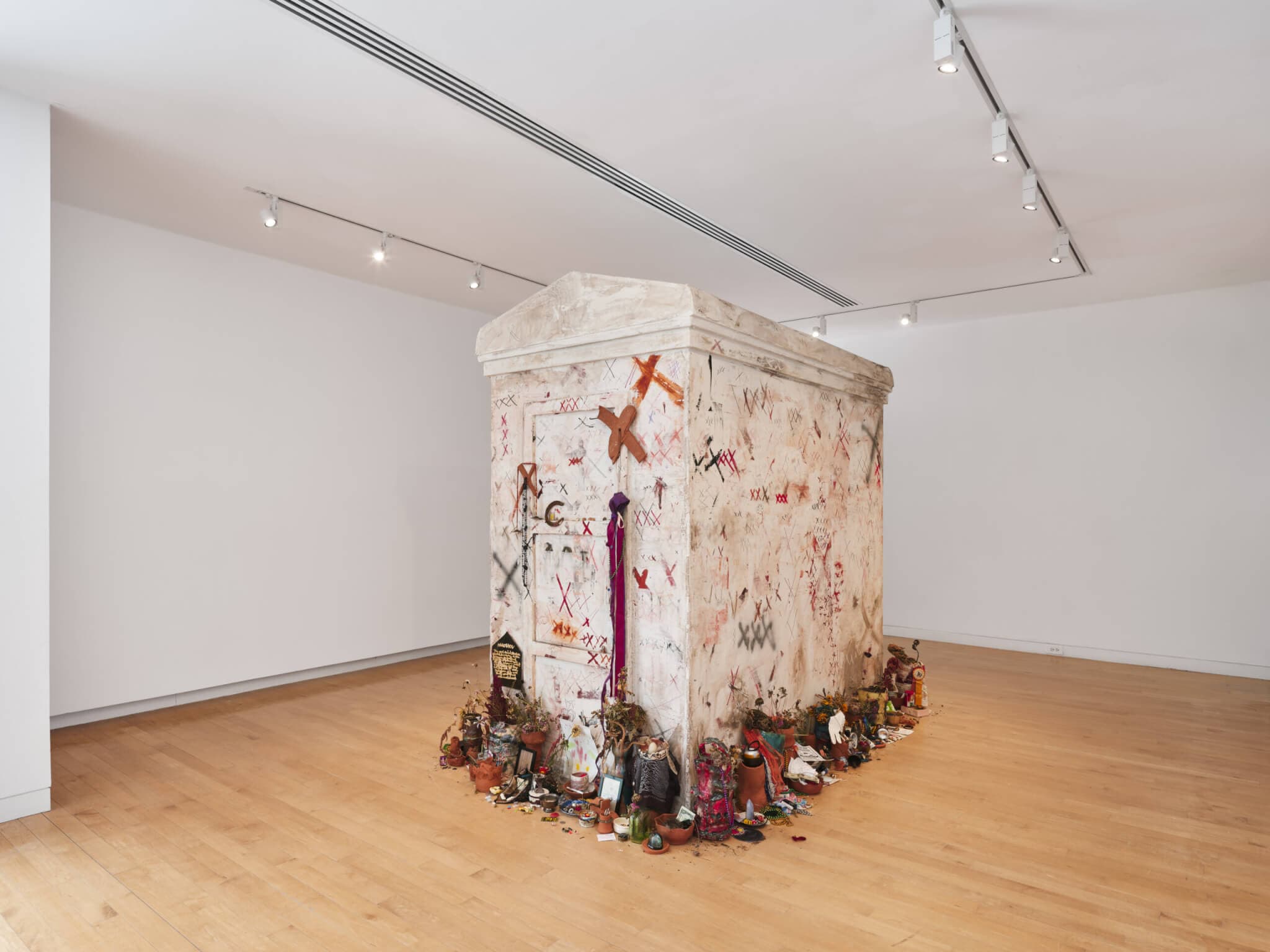
The rear-most gallery space is narrow and perfectly suited to hold Lee’s large-scale tomb-turned-altar Marie (2022). The work is a recreation of the tomb of Marie Catherine Laveau (1801–1881), the “Voodoo Queen of New Orleans.” Lee rebuilt the mausoleum from a nearly thirty-year-old memory of visiting the site. Visitors had been making pilgrimages since Laveau’s death to make offerings and mark three Xs on the tomb as a way to request favors from the deceased. Here in the gallery, visitors are invited to make their own X marks on the recreated tomb. They can also leave their own offerings among the artist’s ceramic vessels, Lee’s garden-grown flowers, and other humble contributions such as lottery tickets, gum, books, and coins piled and scattered at its base. In another audio recording, Lee speaks about visiting the site as a young artist to make a campy horror film with a friend. The recording reveals the feelings of nostalgia and loss wrapped up in recreating Laveau’s tomb now that the site is so changed. When Lee visited, her tomb had been available to visitors for generations. Hurricane Katrina and an act of intense vandalism led to the cemetery’s closure, now only open to visitation via ticketed and timed tours—a site of community reverence and spontaneous creativity turned into a zone of exclusivity for those with money and time enough to visit only as tourists.
“Jennie Jieun Lee: Luteal Elements and Grooves” is a poignant exhibition highlighting the interconnected experiences of memory, body, and loss as well as community care and collective creativity. Lee leaves a lot of room for the audience to enter and interpret her ideas; what she offers is more poetic than didactic—like memory, it will be different for each viewer.
“Jennie Jieun Lee: Luteal Elements and Grooves” is on view through May 25, 2026, at the Aldrich Contemporary Art Museum, 258 Main Street, Ridgefield, Connecticut.