Louisa Penfold grew up in remote areas of Australia where sports ruled and opportunities for the arts were rare. But thanks to her teacher mom and forester dad, art-making and free play in the great outdoors were touchstones of her childhood. “My mom, who’s a high school home economics and textiles teacher, was always collecting different materials and doing all these creative things with us at home,” Penfold recalls. “And I was living on a property that had a huge bushland, so my brothers and I would go and play out there. That free, open play in nature—and having a parent who valued that—gave me a lot of opportunity.”
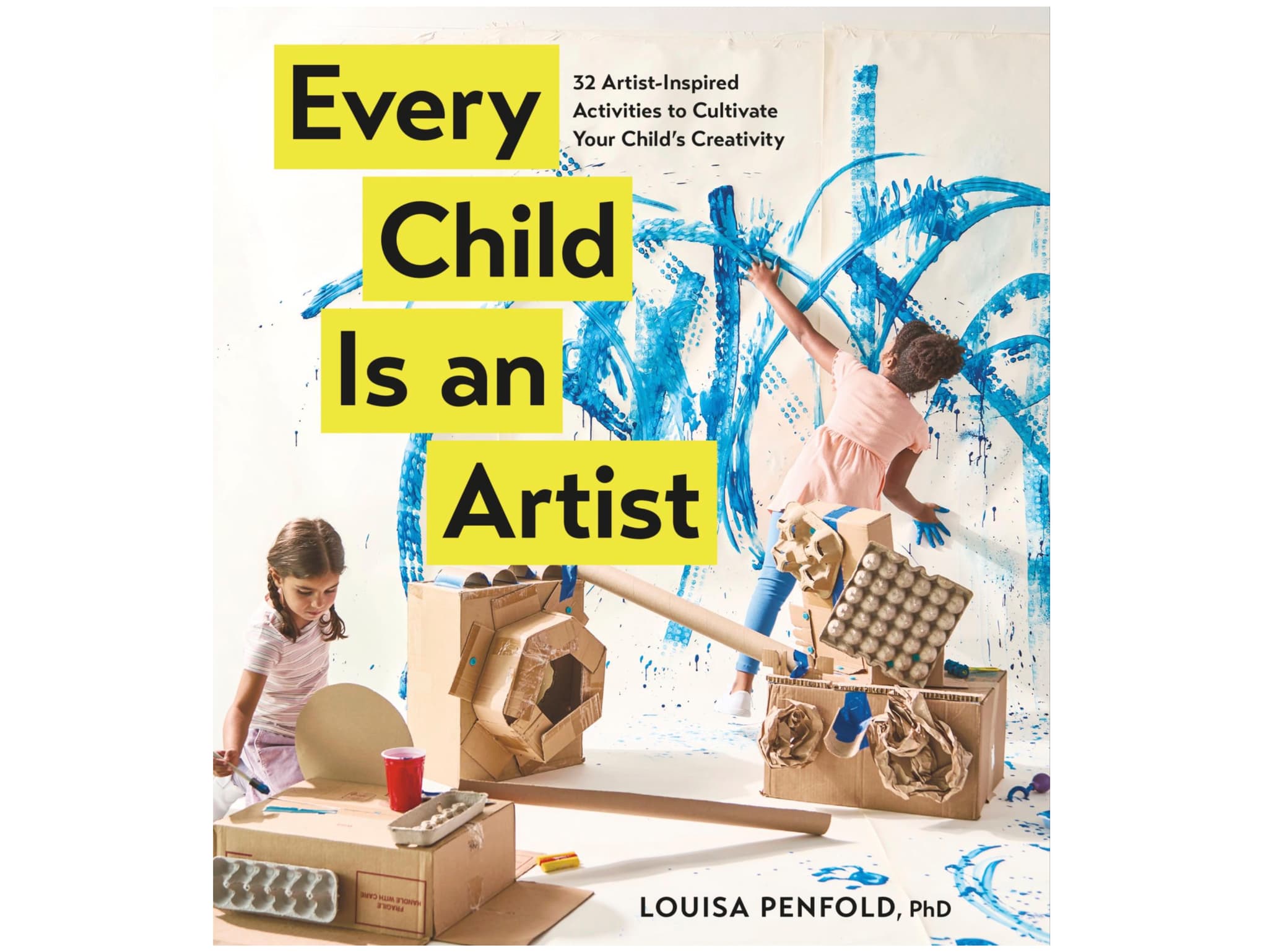
Today, Penfold is a lecturer at the Harvard Graduate School of Education whose work examines the roles of contemporary art, early childhood, and play across schools, museums, and public spaces. (Her popular class Contemporary Art in Early Childhood always has a waitlist.) And now she’s the author of Every Child Is an Artist, a hands-on guide to cultivating kids’ creativity being published on September 29. Aimed at parents and caregivers, the book features thirty-two projects inspired by the work of an international roster of contemporary artists—Lauren Halsey’s maximalist collages, Néle Azevedo’s ice sculptures, Brandon Ndife’s nature constructions, Naomi Hobson’s photo portraits, and Melissa Cody’s intricate weavings, to name a few. Boston-area readers will note some local muses: Color-scape installations riff on Rana Begum’s No. 1318 at the Museum of Fine Arts, and cardboard sculptures take cues from Louise Nevelson’s Total Totality II at Harvard Art Museums. There’s even an action-painting activity inspired by the work of Cambridge artist (and BAR cover subject) Cicely Carew. Penfold will be at Cambridge’s Gather Here for a launch event on October 3, but first, she spoke with me about the book’s backstory, her work with Boston Public Schools, and tips for enjoying art with tiny museumgoers.
This interview has been edited and condensed.
Jacqueline Houton: Where did the idea for this book begin?
Louisa Penfold: I had the idea during the late stages of my PhD. I was meeting all these cool people and reading all these cool things, and I had a WordPress blog. I think the readership was, like, my mom and my aunt for the first few years. But then people started following it, and it was really written toward people working in the field—teachers, museum educators, people like that. I had a really close friend at the time who didn’t work in early childhood; she was a lawyer. But she would read the blog, and she had little kids, and she’s like “Hey, you know, this stuff would be of interest to parents. I want to know how I do this stuff with my three-year-old.” So then I started developing Instagram posts that were more tailored to parents. Then the pandemic hit, and all these parents were at home. That was when I started doing blog activities for parents. There was part of me that knew deep down I wanted to write a book for families because all my friends were starting to have kids and asking me what they can do with them. And I think that there are a lot of gems of knowledge within the early childhood sector that are relevant to parents as well.
Finding the right home for the book, though, was a challenge. I definitely got rejections, and I’m so grateful I got those rejections because they were from people that were not the right fit. I had a couple of publishers who were interested, but they just didn’t get the book. They were like “Can you do two-minute STEM activities?” And I was like “No.” I knew I really wanted to have the focus on families and kids of different ages playing together, and I wanted the focus on contemporary art. And I’m so happy with the final product. The art director had done quite a few cookbooks, and I think that stood us in really good stead for this book. It’s clear; it’s communicative. The pictures share really important information around setup. It’s hands-on and practical. And I really hope it’ll be useful to parents all around the world.
JH: In a lot of books about art for kids, the artists featured are long dead, and the roster is often really Eurocentric. So it feels noteworthy to see this diverse lineup of contemporary artists, including plenty born in the 1980s and ’90s. How did you approach selecting the artists whose processes inspire the activities?
LP: Some artists are ones whose work I’d come across exploring cities and going to different museums and reading different books. And I’ve had the privilege of working with many of the artists in the book over the years, in Australia, in London, in Boston. Cicely Carew lives in Cambridge, and I’ve run workshops with her for Boston Public School teachers. She’s an amazing artist, and when we brought her into the classrooms to meet the kids and the teachers, she shared her creative process for how she creates her paintings—of how, as an adult, she engages in these processes of play. I think I first came across her work when she had the show at the ICA, and I had just gotten a grant from the National Endowment for the Arts to do work in the public schools. And I was like “Oh, my gosh, I have to reach out to her to see if she would be interested in doing some stuff with the teachers and the kids.” And she was, which is great. What I also find really interesting about her practice is that she is a visual artist—she works across sculpture and painting—but she also does yoga and sees that kind of creative movement as a form of play. And she’s such a colorist and brings all these different mediums together, so I was thrilled to be able to position that really centrally in the book.
JH: Yes, the action painting activity even ended up as the cover photo! Speaking of, the photography is such an important part of the book, and I understand that there was a five-day photo shoot, which I imagine must have been fun and challenging. What was that like?
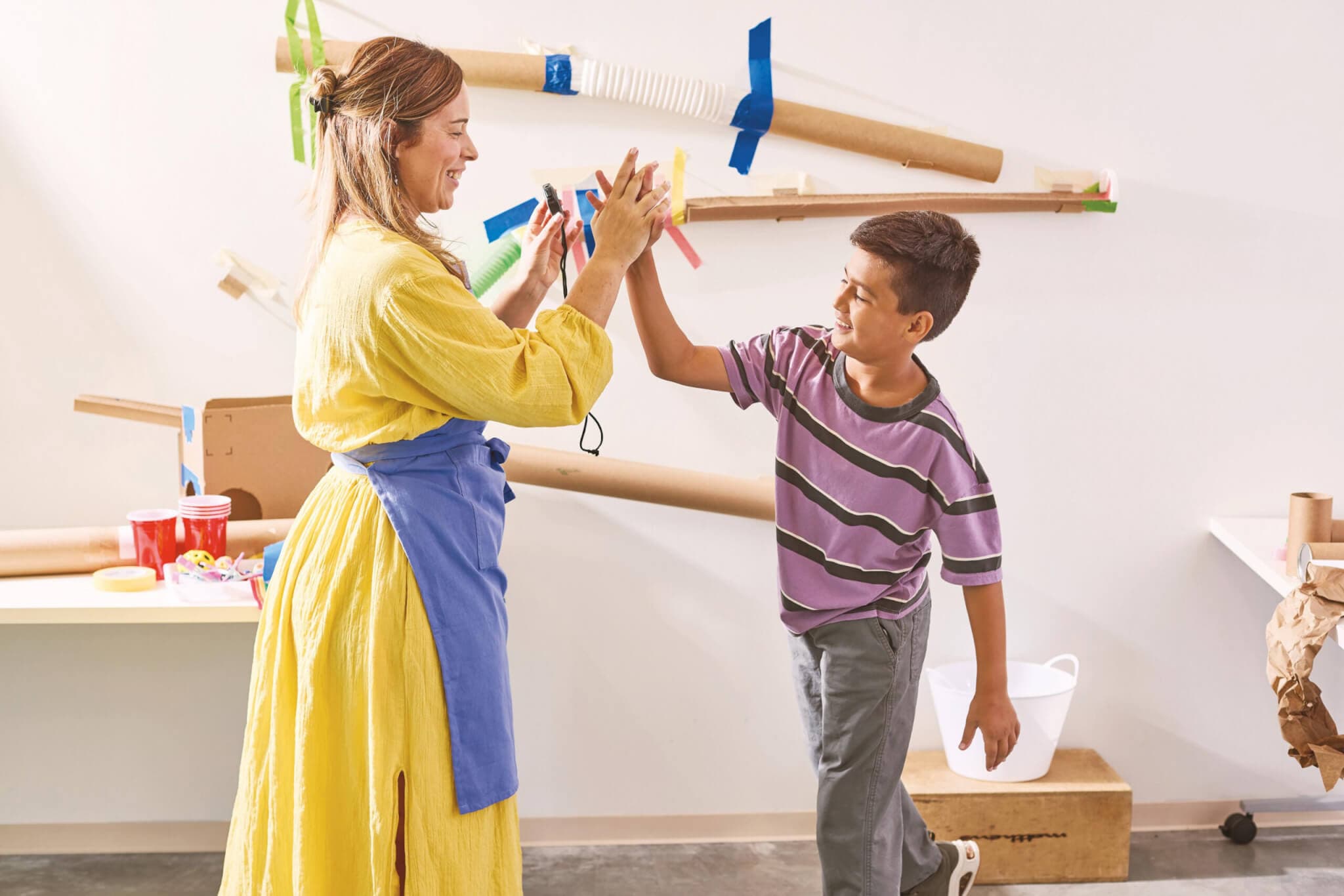
LP: The photo shoot was so much fun. It almost felt like a mini film shoot. We had the photographer, photographer’s assistant, stylist, and art director come up from New York. And then I had a group of some of my wonderful former students from the Harvard Graduate School of Education who came and helped, and they were all folks who had worked with kids before. The photographer, Carl Tremblay, was awesome. He was so respectful toward the kids, and he would just give them time and space to make and play. All the activities in the book I have done with kids for years. But what was really lovely was seeing the kids do them all back to back and being so into it. There were a lot of kids who I’d met through being in Somerville. The little girl on the cover—the one with the paint—I met her because she and her dad were selling homemade jewelry she had made at Somerville Open Studios, and she started selling it at the front of her house. I was chatting with them a couple of months before the photo shoot happened, and then I bumped into them at Market Basket again. I’m like “Hey, I’m doing this photo shoot next week. Do you want to come?” And they were like “Yeah, we’ve got nothing to do. We’ll come.” And then she’s on the front cover. Many of the other little kids live around the corner from me in Somerville, and there are kids from Boston Public Schools. Seeing all these little special humans that I’ve worked with over the years come together was really moving. The thing that was tricky in the photo shoot was they didn’t want to stop doing the activities. We were on a time crunch; we had twenty minutes for each activity, so there was an element that didn’t feel quite as organic. But the photo shoot was still really fun.
JH: You mentioned your work with Boston Public Schools, which has included your role as a project director at Project Zero’s Art|Play, a research initiative that investigates how to integrate contemporary arts practices into public school curriculum. Could you tell me more about that work?
LP: We were working closely with the Department of Early Childhood at BPS, but then also three different art museums—the Harvard Art Museums, the Smithsonian Learning Lab, and MoMA—to utilize different artworks and archival stuff from their collections. So we spent eighteen months running different workshops with teachers and helping develop the Focus curriculum, which is now rolled out not only across all the BPS three- and four-year-old classrooms, but also implemented in Washington, DC public schools and in Louisiana, in Montana. It’s an open-source curriculum. It was wonderful to work with BPS because BPS also has a history of really advocating for the arts in curriculum—like if you’re familiar with the Arts Expansion stuff they did. So this was a continuation of working with the district, which had invested a lot in the older kids and the arts, and now it was time for us to focus on the little kids. These workshops were really important for thinking about connections between arts activities and different state standards in terms of young children’s learning and development—not just in terms of academic learning, like math and literacy, but also around learning to negotiate and collaborate and listen to others and experiment with new ideas. Those things are critical, especially in an age of AI, where the arts and tactile learning, learning through your body, is more important now than ever.
JH: Can you speak a little more about that—about the role of the arts in education in an age of AI?
LP: Standardized testing in math and literacy has really shaped a lot of what’s happening in the classroom, and that’s led to a real marginalization of the arts. There have been issues in education around rote learning for a very, very long time, issues that predate screens, that predate any sort of AI, where children have been seen as these empty vessels that need to be filled up with knowledge. That has been a really detrimental way of thinking about education that’s been in existence for decades. And it becomes even more exacerbated in this time of AI, when a lot of these generative AI technologies are able to do that rote learning in a way that is faster and more accurate than humans. So we need to rethink what we are teaching in schools and how we’re teaching it. And we need to recognize the importance of creative critical thinking and giving children opportunities to learn skills like listening, like empathy, like how to tell stories through all different sorts of mediums, how to communicate feelings through paint and movement and sound and how to sit with uncertainty and develop resiliency. The arts play a really important part in that because to me, the arts are all different languages. Paint is a language, movement is a language, clay is a language, and these are different languages that allow children to think and learn and communicate in ways that words and numbers cannot.
JH: Your doctoral research at Tate Modern looked at the design of children’s creative spaces at art museums. What are you seeing that’s exciting right now in the museum space? Or that needs improvement?
LP: I think museums are really rich spaces for children’s learning, and I’m very heartened to see new initiatives such as Mayor Wu’s work around having free museum days for Boston Public School kids. And I think moves like making the Harvard Art Museums free are really positive because they open up access. Coming from Australia and having lived in the UK, museums are free. One of the biggest challenges we face in the US is around accessibility and getting kids and families in the door. So we need to be making sure that families are aware of what is available to them and encouraging cultural institutions to think about how they make their collections more accessible.
JH: The book also shares some tips for enjoying a museum trip with kids—could you share a few here?
LP: If you’re bringing a little human to a museum, a starting point I always use myself is called “See, Think, Wonder,” which is a thinking routine developed by my colleagues at Project Zero. And it’s just a nice way of essentially asking children a series of questions while looking at an artwork that gets them to think about what they’re seeing and what it means to them. So for example, you take your child to Harvard Art Museums and go into the modern and contemporary art wing, and you sit down in front of Louise Nevelson’s Total Totality II. You could start off saying something like “What do you notice in this artwork? What do you see? Do you recognize anything in it?” And then have the children respond and point out their different observations. And then dig into “What does this remind you of? Have you seen anything like this before? What does this artwork make you feel when you see it?” And then finish off with “If you could ask the artist anything about this artwork, what would you ask them? What questions does it make you wonder?” And that kind of three-step routine, you can use that on anything. You know they make those little fairy houses? In my neighborhood in Union Square, there’s quite a few of them. You could do that “See, Think, Wonder” routine with something like that as well. It can be literally with anything. But I think it’s a way of getting children to slow down, to look carefully, to notice, and to think about what an artwork means to them.