OnlineMay 22, 2026

In “Interlaced, Interwoven,” Jewish Ritual and Contemporary Craft Converge

At Mayyim Hayyim, mosaicist Mia Schon and weaver Josh Kurtz bring their works, shaped by family history and ritual practice, into dialogue.

Quick Bit by Emma Breitman

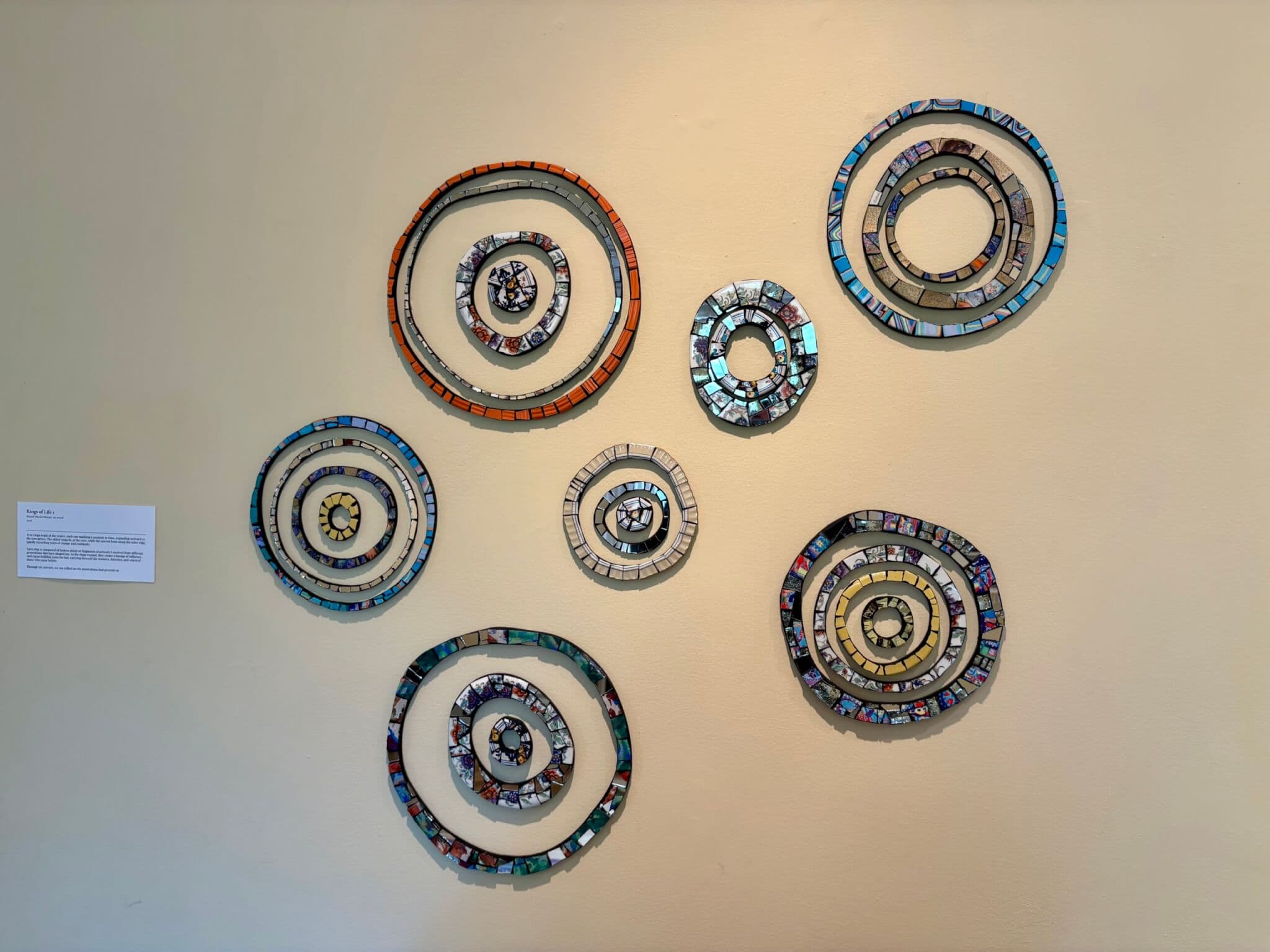
Multiple circular mosaic artworks hang on a gallery wall.

Mia Schon, Rings of Life 1, 2026. Mixed media mosaic on wood. Photo by Emma Breitman.

Founded in 2001 by Jewish feminist Anita Diamant, Mayyim Hayyim, Newton’s mikvah (Jewish ritual bath), has been redefining ritual immersion to make the practice more accessible to Jews of all races, genders, and levels of religious observance. In its most traditional form, Jewish people visit the “living waters” as a mode of spiritual purification. For women in particular, “purification” has been a vessel through which patriarchal ideologies are upheld. Instead, Mayyim Hayyim has reimagined the ritual to be a space for radical healing and justice, even offering immersions for survivors of trauma, illness, and loss. As part of its mission, Mayyim Hayyim has also built up a smorgasbord of educational offerings to connect the Boston Jewish community, and the Jewish diaspora more broadly, to the ritual.

Their most recent community engagement is “Interlaced, Interwoven,” an exhibition developed in partnership with the Vilna Shul, showing the work of mosaicist Mia Schon and weaver Josh Kurtz. The two local artists make up half of the 2025 Community Creative Fellowship cohort, a program launched by Combined Jewish Philanthropies and the Vilna Shul in 2020 to uplift Jewish artistry. Hung on the walls of Mayyim Hayyim’s Paula Brody and Family Education Center, the two artists’ works are nestled alongside one another and dispersed throughout the space, allowing each artist’s ancient medium the opportunity to form a dialogue with the other.

Schon’s sculptural tilework carries familial history, layering dishware fragments that tell the story of a matrilineal lineage. Sorting through her own plates, along with those of her grandmother, mother, and daughter, Schon reveals in Rings of Life 1 and Rings of Life 2 (both 2026) how the generations before us shape our existence. Imperfect rings in varying sizes that range in color, sheen, and pattern expand outward, mirroring the bands embedded within tree trunks used to determine a tree’s age. These works nod not only to the Tree of Life, a Jewish mystical symbol representing divinity, but also to the artist’s own family tree.
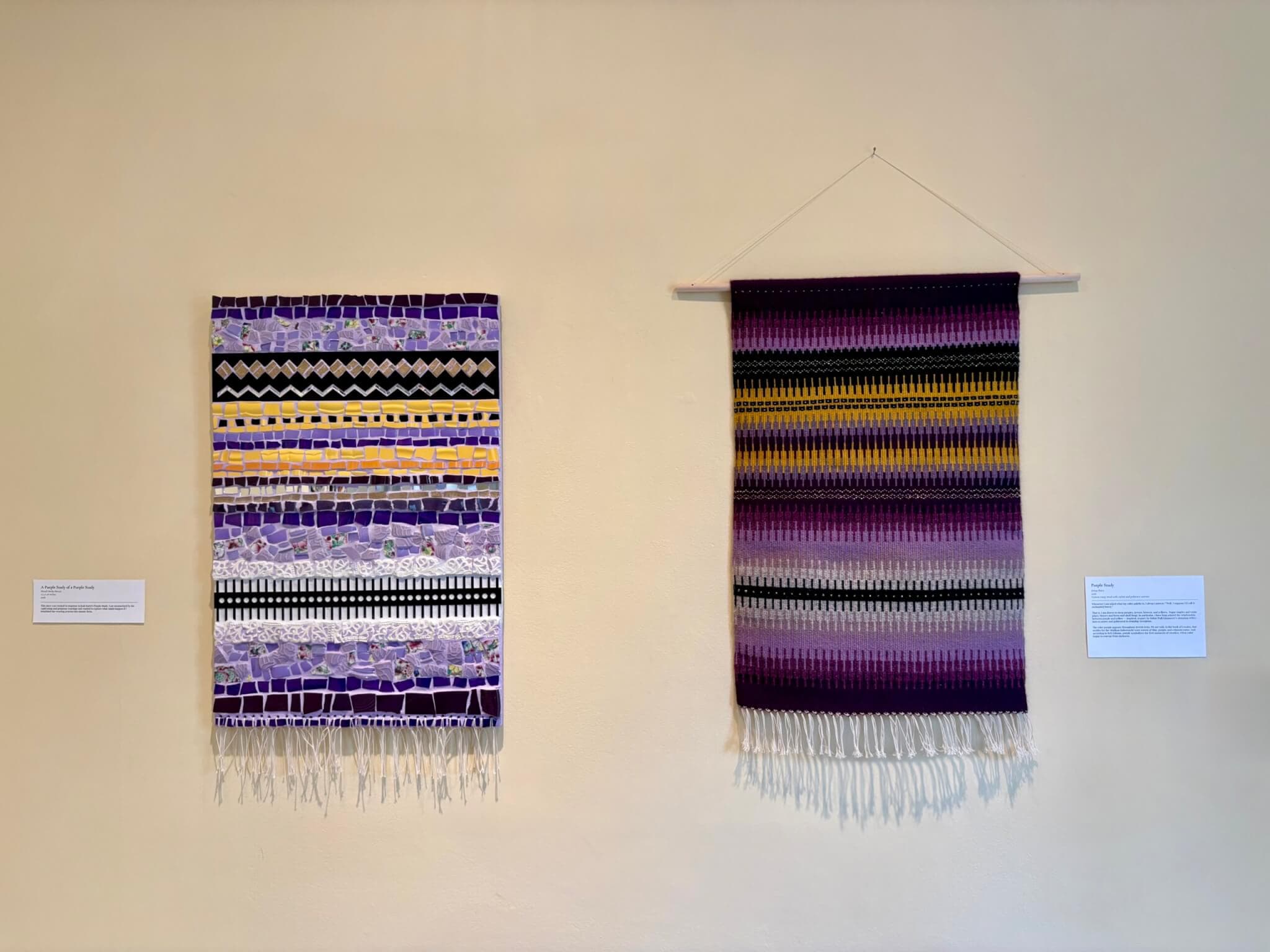

(left) Mia Schon, A Purple Study of a Purple Study, 2026. Mixed media. (right) Josh Kurtz, Study in Purple, 2026. Cotton wrap, wool weft, nylon and polyester accents. Photo by Emma Breitman.

Kurtz’s four- to five-foot-tall geometric tapestries draw their vibrancy from Jewish mystical teachings on color and their associations with divinity. Weaving together liturgical texts and rich yarns, his work joins an ancient fiber process with ancient knowledge, finding the sacred in seemingly repetitive acts or commonplace objects.

In Purple Study (2026), Kurtz turns to Jewish texts that link the color to the first moments of creation, exploring how vibrancy emerges even in the darkest moments. The tapestry flows from deep plum to lilac, marigold yellow to a violet-hued black, sprinkled with silver-threaded details that conjure images of celestial creation.

Placed directly to its left, Schon’s A Purple Study of a Purple Study (2026) translates Kurtz’s weaving into a large-scale mosaic rectangle, following a similar size, shape, and structural pattern to a tapestry, and even includes dangling white threads knotted simply at the bottom edge of the piece. While these threads are commonplace in Kurtz’s woven pieces, in Schon’s response, they take on the additional meaning of Jewish tallit, or prayer shawls, adorned with strings at each corner of the fabric meant to remind the wearer of the Ten Commandments.  

When viewed together, the two artists’ work demonstrates how ancient artistic mediums can be infused with new life that still honors tradition. The exhibition’s grounding in such an unprecedented institution that is also focused on reimagining tradition makes the work all the more potent.


Interlaced, Interwoven” is on view through July 2026 at Mayyim Hayyim, 1838 Washington Street, Newton, MA.

Emma Breitman

Contributor

More Info