This feature originally appeared in Issue 15, published October 25, 2025. You can read this piece and more by purchasing a copy of or subscription to the magazine here.
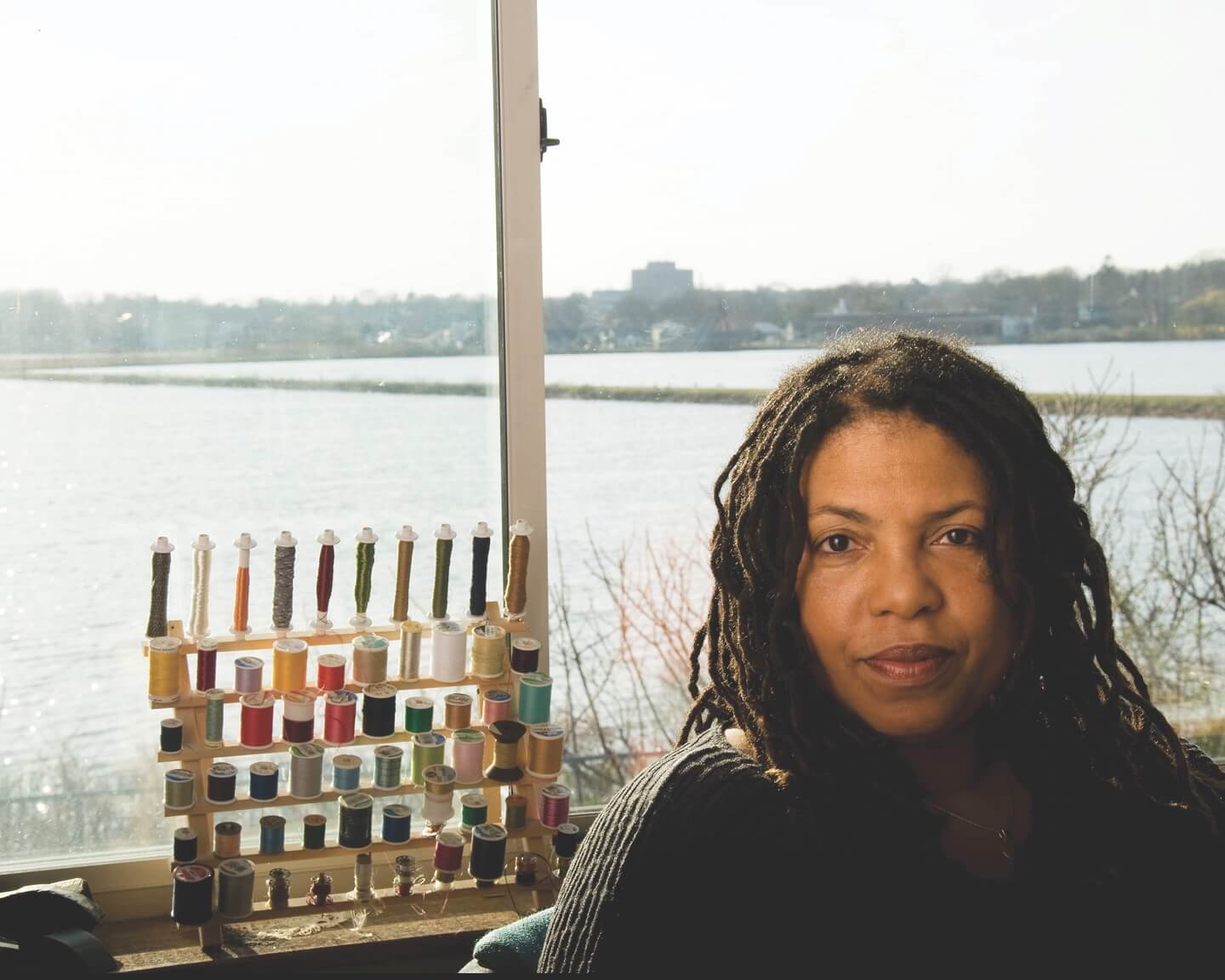
The layers accumulate slowly in Donnamaria Bruton’s paintings, just as they did in her life. Paint mingles with collage, graphite, and paper, creating visual maps that chart territory between the material and spiritual worlds. These layers tell the story of an artist who understood consciousness itself as her primary medium, revealing ethereal dimensions that stand as both aesthetic achievements and spiritual portals. Ten years after her death in 2012, her 2022 retrospective at the Newport Art Museum, “From Sense to Soul,” marked the first comprehensive examination of her work since her death, prompting overdue reassessment of an artist whose contributions are only now receiving deserved attention.
Bruton worked primarily as a painter and mixed-media artist throughout her life, creating fantastic large-scale canvases that incorporated graphite, acrylic paint, printed papers, ribbon, and collaged imagery alongside sculptural dresses and dolls. Her passing from lung cancer cut short the career of an artist who had quietly shaped both contemporary painting and institutional leadership in New England. The archival materials, family interviews, and institutional records about her life reveal an artist whose influence extended far beyond her own artwork through the students she mentored, the barriers she broke, and the hope she offered for what the study of art could become.
Consciousness from Childhood
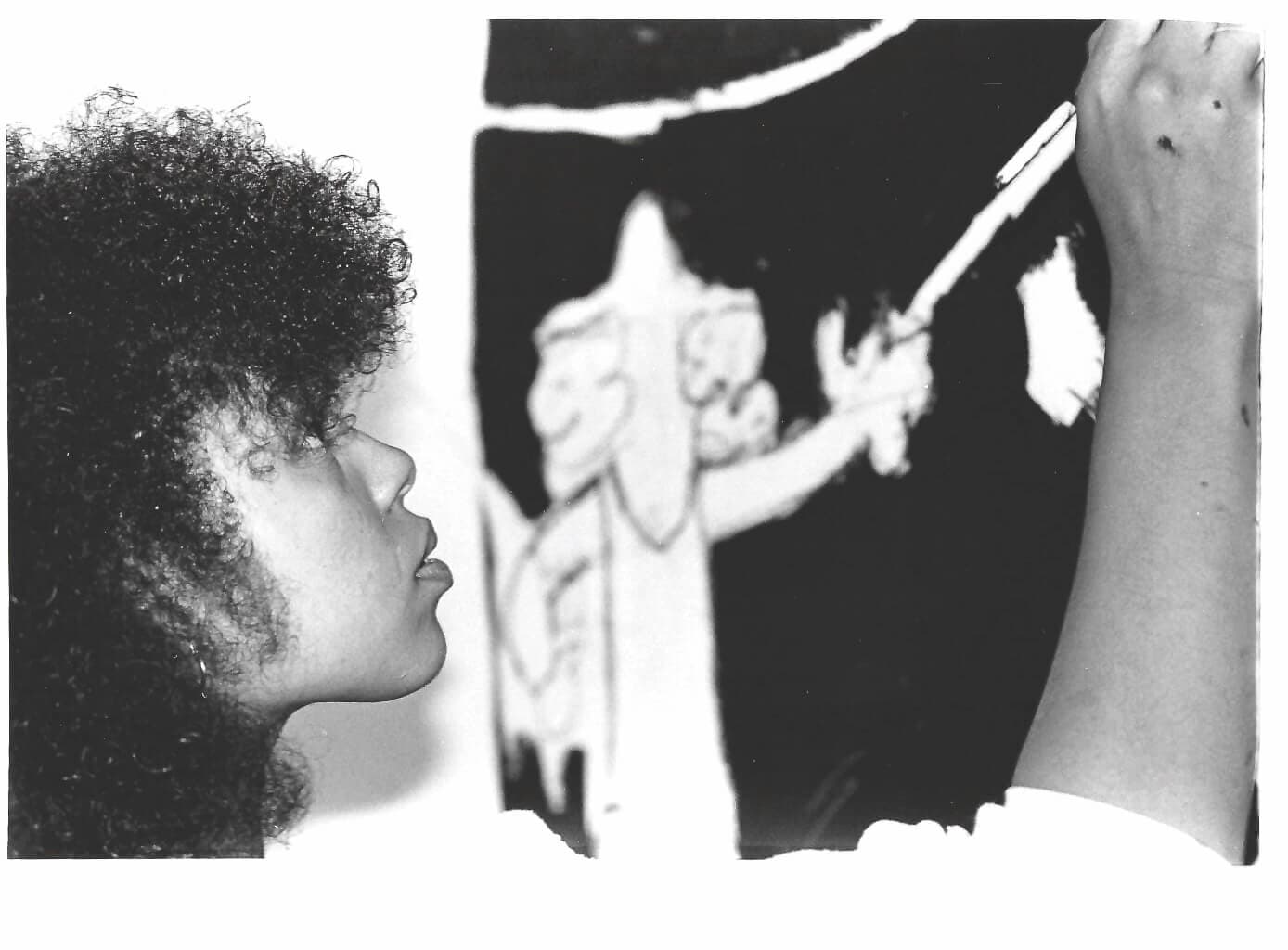
Donnamaria Bruton was a daydreamer. Poring over boxes of her personal archives at Cade Tompkins Projects in Providence, RI, including handwritten journals, typed reflections, and scattered notes spanning decades, I uncovered her descriptions of how, as a child, she would find herself suspended between states, completely conscious yet certain she was in a dream. These moments arrived without warning, she wrote, small ruptures in ordinary time that she never discussed with anyone but carried within her always. Years later, standing before canvases that stretched six feet in each direction, she would recognize these childhood experiences as her first encounters with what she called “states of consciousness,” the territory her art would spend a lifetime mapping.
Healing Source (2002–06) exemplifies how Bruton translated consciousness onto canvas. The seventy‑two-inch-square surface holds acrylic paint, collaged elements, and graphite marks from four years of patient building, creating a cartography of material and psychic matter. Reflective papers scattered throughout indicate what Bruton called “the presence of divine light,” which she believed could manifest “under any circumstance.”1 Each addition represents a different state of awareness, building toward what she called “spiritual perception,” an insight guided by spirit as opposed to external impositions.2
Born in 1954 to her mother, Loretta, a store clerk, and father, Bill Bruton, a professional baseball player who moved the family from Milwaukee to play for the Detroit Tigers when she was nine, Bruton grew up in a household where art held equal importance to athletics. A painting by the renowned landscape artist Edward L. Loper Sr. hung over the family fireplace, creating her first sustained encounter with fine art painting. Loper, married to her father’s sister and the first African American to win a prize from the Delaware Art Museum, became a crucial bridge between Bruton and modernist traditions. Between her undergraduate years at Michigan State University, where she earned a BFA in graphic design in 1976, and her 1991 MFA in painting and printmaking at Yale University, she studied with her uncle in his Delaware studio and made frequent visits to Philadelphia to study at the Barnes Foundation. There she encountered the foundation’s philosophy of “learning to see” and absorbed foundational art history lessons about color relationships and compositional structure.
The convergence of these early experiences, including her childhood visions, her uncle’s meticulous mentorship, and her foundational studies, shaped an artist who was a study in contradictions that formed a coherent whole. Family and friends describe her as both serious and playful, an introvert with a magnetic presence that drew people without effort. She could be demanding, holding high standards, yet approached art with childlike wonder, experimenting with unconventional materials like pom-poms and glitter long before they gained acceptance in fine art circles. Her rebellious streak coexisted with deep spiritual devotion; she hosted Sunday services in her studio and spent hours in thought. She was endlessly curious, trying everything from felting to glassblowing and incorporating these experiments into her paintings. She was, as her sister Jacquie put it, “a quirk within herself,” moving seamlessly between John Coltrane and Salt-N-Pepa, expressing her vibrant interior life through everything from her red kitchen to her eclectic artistic practice.
As a free spirit of sorts, Bruton harbored a hesitancy about formal painting techniques, preferring abstract expressionism. “I learned the foundations to painting in his [Loper’s] studio but also I had doubts about a great many things,” she wrote, describing Loper’s “strict adherence to paint application” as one source of her questioning.3 These doubts propelled her toward developing a surrealistic way of seeing, a style that favors spiritual and emotional transparency. The compositional techniques she would adopt throughout her education/exploration allowed her to build multiple planes of awareness into single sites and offered a visual liminal state through which to question one’s existence, exploring moments of transcendence when subjective and objective states of consciousness collide.
The Evolution of Spiritual Practice
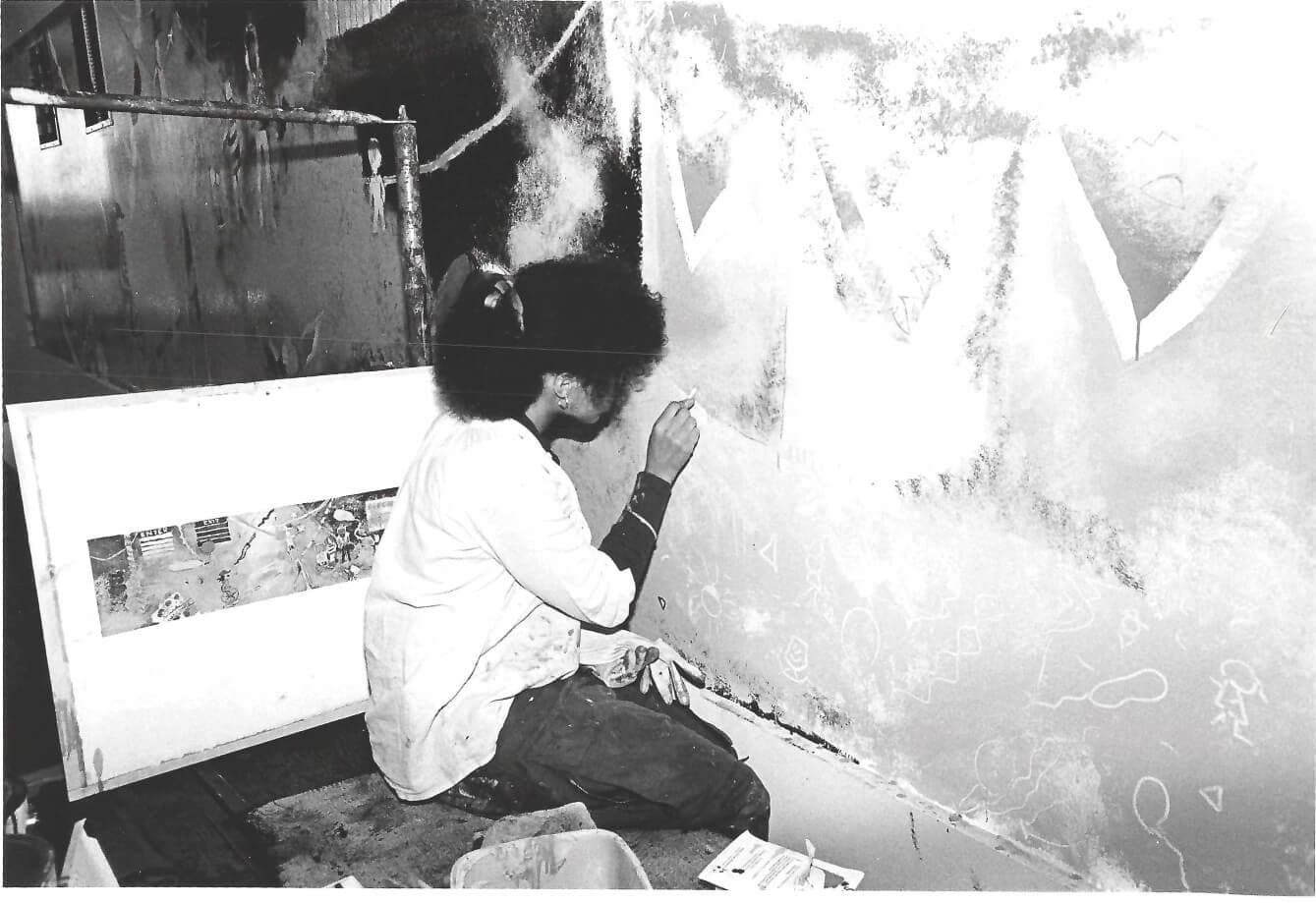
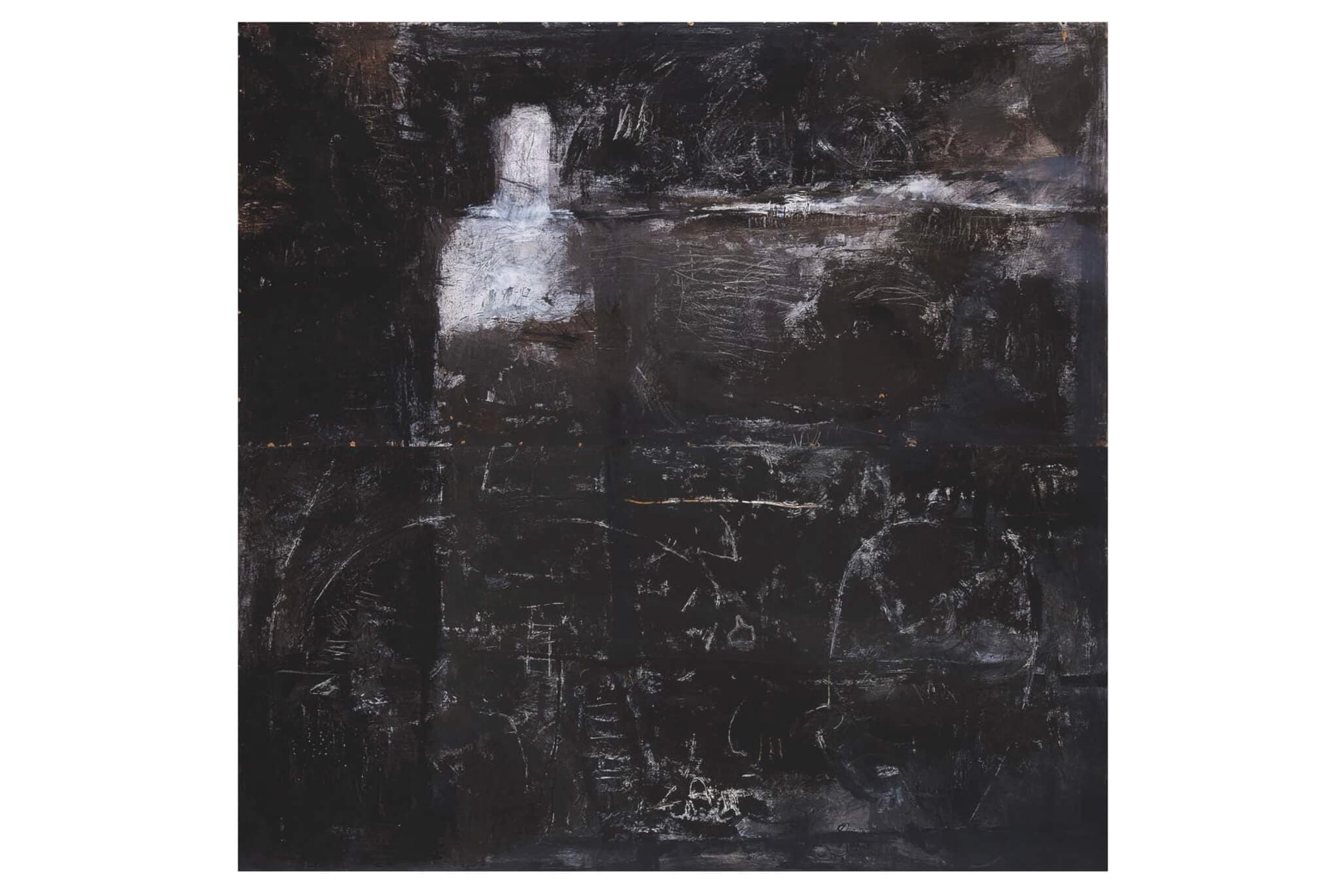
Bruton’s artistic evolution reveals a deliberate progression from darkness toward light across two decades, with her storytelling shifting from expressions of struggle to enlightenment. Her early work from the 1990s, exemplified by Strong Soul Survivor (1990), came from what might be characterized as her dark period: brooding, expressionistic canvases dominated by black and brown pigments that tangled with psychological turbulence. These works established her commitment to interior landscapes, but their emotional weight suggested an artist still grappling with the consciousness she sought to understand. The heavy impasto and gestural mark-making of this period reflect the challenge of maintaining spiritual awareness while navigating worldly concerns. In the studio, Bruton’s process was fundamentally intuitive and rooted in an African American art tradition she described as “feeling the work.”4 This affective approach positioned her within a rich lineage of artists exploring the intersection of African diasporic cultural forms and contemporary practice. Influenced by the jazz and blues rhythms of artists such as Romare Bearden, she completed her works through processes of improvisation and intuition. In her careful orchestration of paint, color, line, marks, emotion, and experience, Bruton created a kind of call-and-response communication that transformed the painting process into an articulation of interiority.
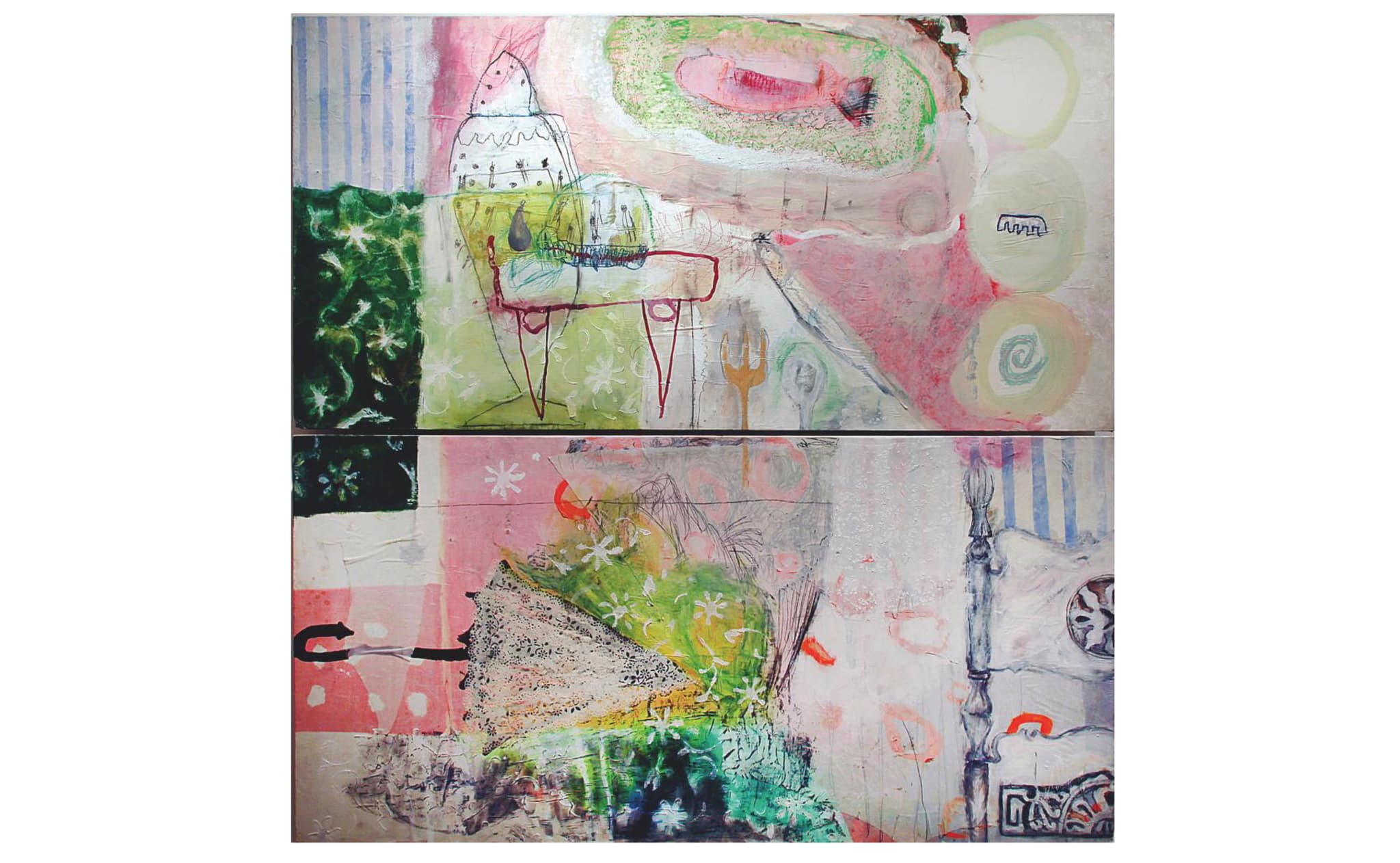
The transition toward spiritual lightness becomes visible in Personalities are Portable (1995), where Bruton began incorporating the mixed-media techniques that would define her mature style. The oppressive weight of her earlier paintings gives way to a more buoyant exploration of identity and consciousness, with lighter colors and varied textures suggesting newfound spiritual freedom. The title suggests her evolving understanding of selfhood as fluid, stemming from the idea that spiritual awareness functions independently of material circumstances. This work marks a pivotal point where her spiritual practice began to reshape her storytelling approach, moving from expressions of struggle toward the creation of healing visual experiences.
By 2010, in works like Conjugating Mary, Bruton’s storytelling had fully evolved into what might be called visual prayer. The painting layers decorative patterns with iridescent paper that catches and reflects light at different angles, creating a sense of movement and transcendence that draws viewers into prolonged contemplation. The work’s title suggests both linguistic change and spiritual metamorphosis, allowing painting to conjugate consciousness across different states of being. The composition demonstrates her mastery of what she called “visual intelligence,” where every decision serves both aesthetic and spiritual purposes.5 This evolution from the dark expressionism of Strong Soul Survivor to the luminous spirituality of Conjugating Mary reveals an artist who learned to channel personal struggle into universal healing through the alchemy of paint and canvas. For Bruton, spirituality functioned as both subject and method. Her artistic practice embodied the tension between spiritual consciousness and superficial worldly concerns, using material elements as conduits for deeper meaning rather than ends in themselves. “I access it through silence, stillness, prayer and study,” she wrote in her notes.6 Her paintings aimed to elevate viewers from limited physical understanding to infinite spiritual awareness. Beyond the physical borders of frame, she fashioned the paintings into meditation stations for reception, channeling, and clarity. She believed that waiting was essential: “I don’t think a painting will wait for you but I think you have to wait for the painting.”7
Feminist Art-Activism
As the feminist movement of the late twentieth century gained momentum through literature and collective action, Bruton offered her own form of critique through art: targeting misogyny and fat phobia in the fashion industry. Bruton’s feminism focused on agency and social truths, exploring different territory from the rights-based activism that characterized much feminist art of her generation. Her approach drew from the writings of bell hooks, particularly hooks’s integration of feminist theory with spirituality and her emphasis on Black women’s consciousness-raising as a tool for liberation. Bruton applied these concepts through collage and three-dimensional art, creating works that challenged women to examine their relationships with self-worth and the body. She also found inspiration in Judy Chicago’s commitment to making women’s experiences visible through collaborative projects and alternative exhibition spaces. Where Chicago created communal experiences like The Dinner Party (1974–79) to honor women’s historical contributions, Bruton developed mathematical formulas and sculptural installations to expose contemporary beauty standards, molding critique into full-figured forms that visitors could walk around and experience physically.
Currents of gender studies crystallized in her Calculation Project, an early 2000s commentary on beauty standards as violence against women’s psychological and spiritual well-being. The idea evolved from Bruton’s everyday catalog shopping, through which she examined how imagination alters self-concept when visualization becomes the basis for consumer decisions. The mathematical formula she developed calculated the height, weight, and volume that women would need to achieve to meet contemporary fashion industry ideals, revealing the absurdity of standards that treated human bodies as problems to be solved. Through analysis of the gap between commercial imagery and lived reality, she created what she termed “generic shapes for athletic, pear shaped, and [other] body types” that exposed the standardization underlying supposed diversity in fashion marketing.8
The project’s vellum dresses, standing eight feet tall and set to fit plus-size women, converted mathematical scaling into impressive sculptural statements. Bruton strategically designed these works for exhibiting in shopping malls, storefront windows, and college campuses, placing her critique directly within the spaces in which issues of body image and beauty standards are prevalent. Using measurements from herself, her sisters Jacquie and Denise, and others, Bruton created dresses based on actual women’s bodies that emphasize the “disparity between images and objects used in advertisement and real life.”9 The dresses were embellished with comic book images, fur, and artificial flowers, creating multimedia objects that revealed the absurdity of treating women’s bodies as raw material for fantasy and consumption. Each dress was approximately twenty-four inches wide by seventy-two inches high by twelve inches deep, suitable for a woman who wears an American size 24, directly challenging the fashion industry’s equation of beauty with thinness.
The Calculation Project extended to modified Barbie dolls, positioning these familiar objects as sites for examining how childhood toys shape adult self-perception. These dolls experimented with proportions to consider the representations children internalize through play, suggesting how beauty standards are transmitted across generations in sometimes inconspicuous ways. The project was included in the 2002 Gwangju Biennale Art to Wear exhibit in Korea, an international recognition of Bruton’s approach to feminist critique through paper and sculpture.
Making History at RISD
From 2001 to 2004, Bruton was the department head of painting at RISD, becoming the first Black person and first woman to serve in the role. Her appointment marked a shift in how art education might operate when guided by principles of spiritual development alongside technical training. Yet this intervention may have inadvertently contributed to why her artistic legacy remained overshadowed for over a decade after her death. Her sister Jacquie observed that “Donna had the spiritual depth and stamina, to condend with the daily pressures of racism, intimidation, and bias,” but these very qualities that made her an effective institutional leader may have directed attention away from her artistic practice. The institutional records reveal that her position required her to serve as what her husband, Tim Coutis, described as representing “Black America at RISD,” advocating for more Black students and students of color while often being invited to serve as “the face of Black issues on campus.” Following Bruton’s entry to the Department of Painting as a professor in 1992, the college leveraged her presence to successfully recruit the interdisciplinary artist Kara Walker to RISD in 1994.10
This burden of representation reflects a pattern common in academic institutions where Black women educators find their administrative contributions overshadowing their creative work. Bruton’s commitment to education and institutional change, while groundbreaking, meant that her identity as an administrator often preceded recognition of her as an artist. Her willingness to bear what department chair Duane Slick called “the brunt of a small percentage of students’ frustration”11 during campus racial tensions demonstrated her dedication to institutional progress, but such labor typically goes unrecognized in an art world that encourages mass appeal, sales, and awards.
Bruton’s teaching philosophy at RISD emphasized visual intelligence in painting, championing individual discovery over group critique. “My courses are discovery oriented in nature and are directed by a series of assignments that are meant to aid students in their explorations of painting. Exploration is the key word,” she explained.12 Students found her observations “well thought out, articulately delivered and enormously helpful,”13 according to former dean Jay Coogan. Yet this very dedication to nurturing others’ artistic development may have contributed to the relative invisibility of her own creative practice in broader art world discourse, a dynamic that disproportionately affects women artists who choose to prioritize teaching and mentorship.
A “Modest” Legacy
Bruton’s commitment to painting as spiritual practice positioned her outside mainstream contemporary art discourse during a period increasingly dominated by conceptual positioning, market considerations, and intellectual debates. Her approach aligns with what art critic Mira Schor termed “modest painting,” an aesthetic that resists the spectacle of contemporary art culture in favor of what Schor describes as work that “takes on the exploration of what ‘importance’ tramples underfoot.”14 Like the modest painters Schor regards, Bruton privileged the silent, slow, and intimate over institutional expectations of conformity and commercialism.
Donnamaria Bruton demonstrated that authenticity in life and leadership could reshape institutions. “Rising above the human condition has truly been a journey from sense to soul,” she wrote to RISD in 1991. “A pilgrimage to a holy or secret place of refuge. My body of work is a reflection of my ongoing search for truth and the poetry of that experience.”15 When Bruton passed at age fifty-eight, she left behind a body of work that offers a prescient model for how artists might engage with both private practice and public responsibility. Her estate is now managed by Cade Tompkins Projects, which has been instrumental in preserving and promoting her artistic legacy. The gallery’s archival efforts have made possible the recent reassessment of her contributions to painting and pedagogy. In an era when artists continue to wrestle with questions of meaning and purpose, Bruton’s work stands as proof that much of what makes our art special is revealed in the spirit journey along the way.
—1 Donnamaria Bruton, “Statement 2000,” the Papers of Donnamaria Bruton, Cade Tompkins Projects, Providence, Rhode Island.
—2 Donnamaria Bruton, “From Sense to Soul,” the Papers of Donnamaria Bruton.
—3 Donnamaria Bruton, untitled biographical note, the Papers of Donnamaria Bruton.
—4 Donnamaria Bruton, untitled journal entry, the Papers of Donnamaria Bruton.
—5 Donnamaria Bruton, untitled journal entry, the Papers of Donnamaria Bruton.
—6 Donnamaria Bruton, untitled typed note, the Papers of Donnamaria Bruton.
—7 Ibid.
—8 Ibid.
—9 Ibid.
—10 Tim Coutis, interview by author, Providence, Rhode Island, August 7, 2025.
—11 Duane Slick, “Letter of Recommendation for Donnamaria Bruton,” November 11, 1999, the Papers of Donnamaria Bruton.
—12 Donnamaria Bruton, “Teaching Philosophy,” the Papers of Donnamaria Bruton.
—13 Jay Coogan, “Letter of Recommendation for Donnamaria Bruton,” December 15, 1999, the Papers of Donnamaria Bruton.
—14 Mira Schor, “Modest Painting,” Art Issues, January/February 2001.
—15 Donnamaria Bruton, “Artist Statement,” 1991, the Papers of Donnamaria Bruton.
Note: This article draws primarily from unpublished archival materials in the possession of Cade Tompkins Projects, supplemented by interviews and correspondence with Tim Coutis (the artist’s widower), Jacquie Bruton (the artist’s sister), and Courtney Elledge (the artist’s niece). The archival collection, which includes journals, notes, and typed reflections spanning Bruton’s career, has not yet undergone formal cataloging or conservation. Given the unprocessed state of these materials, many items lack formal dating or titling, a circumstance that reflects both the intimacy of these sources and the urgent need for comprehensive archival preservation of Bruton’s legacy.